
12 · Tiered Cache, Cache Reserve, and origin shielding
Consolidate multi-region misses with Smart Tiered Cache, then decide whether object lifetime and economics justify a persistent Cache Reserve layer.
Edited and verified by Orange Book Editorial Team ·
The layers solve different problems
Tiered Cache makes lower-tier locations consolidate misses through fewer upper-tier locations, reducing origin connections. Cache Reserve adds a paid, persistent storage layer for long-lived public objects with expensive origin egress. Neither makes an otherwise private response safe to cache.
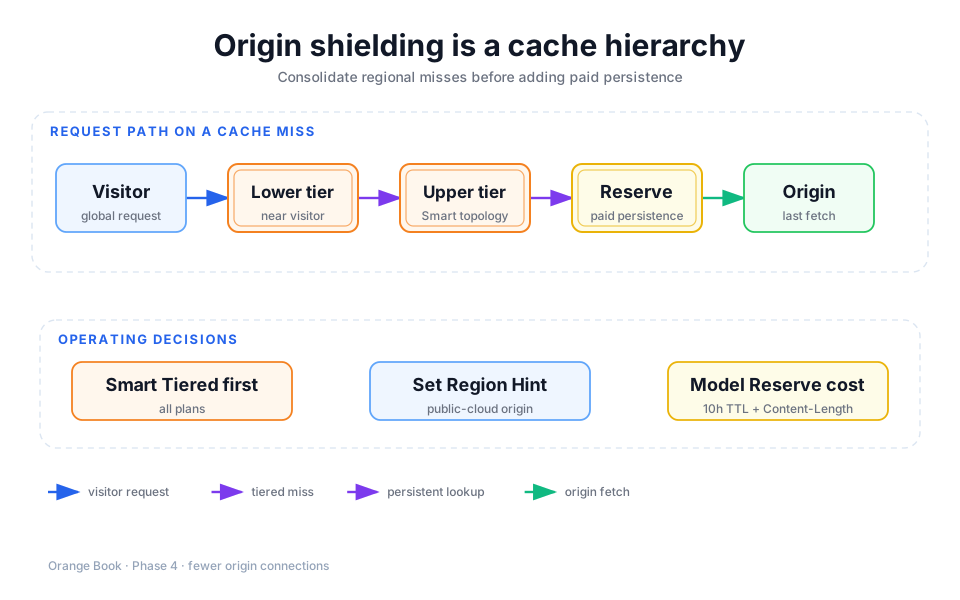
Detailed description
- 01Visitor and lower tier
Serve popular objects nearby without sending every regional miss directly to the origin.
- 02Smart upper tier
Consolidates lower-tier misses to improve global reuse and reduce origin connections.
- 03Cache Reserve
Paid persistence; an object needs at least a ten-hour freshness TTL and Content-Length.
- 04Origin
Provides content only when the preceding layers miss or require revalidation.
Choose Tiered Cache before Reserve
| Capability | Current plan | Good fit | Cost boundary |
|---|---|---|---|
| Tiered Cache + Smart Topology | Free / Pro / Business / Enterprise | Multi-region visitors, one or a few origins | Currently no extra product fee |
| Public-cloud Region Hint | All plans; AWS/GCP/Azure/Oracle | Anycast or regional-cloud origin whose location is ambiguous | Currently no extra product fee |
| Regional / Custom Topology | Enterprise | Complex global origins and bespoke topology | Contact account team |
| Cache Reserve | Paid plan required | Long-lived public large objects and expensive origin egress | Usage-based storage and operations |
For most projects, enable Smart Tiered Cache and measure origin-request reduction before modeling Reserve from real bandwidth costs. Do not turn on every layer at once and guess the benefit.
Enable Smart Tiered Cache
Establish a baseline
Record origin requests, egress bytes, cache-hit ratio, main object sizes, region distribution, and release frequency. Separate identity APIs and uncacheable traffic so a blended hit ratio does not mislead.
Enable Smart Topology
Under Caching → Tiered Cache, enable Tiered Cache and select Smart upper-tier topology. Tiered Cache and Smart Topology are currently available on every plan.
Set a Region Hint for a public-cloud origin
Under Caching → Tiered Cache → Origin Configuration, find the origin IP or Hostname and select its actual cloud provider and region. Do not infer origin location from visitor geography. A Region Hint describes where the origin runs in AWS, GCP, Azure, or Oracle Cloud.
Observe more than one hit
Compare origin requests, egress, and upper-tier fills before and after. When your request logs expose the field, CacheTieredFill helps confirm that Tiered Cache participated.
Cache Reserve eligibility and economics
An object needs standard cache eligibility, a freshness TTL of at least ten hours, and Content-Length before Reserve can admit it. Default retention starts at 30 days and resets on access. Retention determines whether the object stays in persistent storage; freshness TTL still determines when Cloudflare revalidates with the origin.
As of this page's verification date, public rates are:
| Item | Price |
|---|---|
| Storage | $0.015 / GB-month |
| Class A writes | $4.50 / million operations |
| Class B reads | $0.36 / million operations |
Operation quantities round up to the next million, and rates can change. Recheck official pricing before enabling. Rewriting many short-lived small files can cost more in operations than it saves in origin egress. Repeatedly read, long-lived large objects are closer to the intended fit.
Reserve decision table
| Object | Recommendation | Reason |
|---|---|---|
| Versioned software download or public dataset | Model and test | Long-lived, repeatedly read, potentially expensive origin egress |
| Public originals and long-lived media | Pilot | Originals can qualify; test Range behavior and file limits |
| Dynamic HTML or frequently updated API | Usually unsuitable | Difficult ten-hour TTL and frequent writes/revalidation |
| Private user PDF/image result | Do not use shared Reserve | Authorization and revocation take priority |
| Request to an R2 public bucket on a zone domain | Does not use Cache Reserve | Explicitly excluded by current behavior |
Validate media and invalidation semantics separately
Cache Reserve currently does not support origin Range requests from Reserve, and transformed image variants are ineligible. URL purge immediately affects edge and Reserve. Tag, Host, Prefix, and Purge Everything make Reserve revalidate on the next request, while storage charges continue until retention expiry or deletion.
Acceptance and rollback
- Origin requests and connections fall after Smart Tiered is enabled without degrading 5xx, TTFB, or release freshness.
- A public-cloud Region Hint matches the actual origin region and updates as part of origin migration.
- Reserve receives only inventoried objects that satisfy TTL, Content-Length, cacheability, and public visibility.
- Cache Reserve Analytics shows storage, Class A/B operations, requests, and egress savings before expansion.
- Pausing Reserve does not delete stored data. Full deletion requires disabling it and using Delete Storage; Cloudflare notes that deletion can take up to 24 hours.
The final phase combines non-cache content optimization, dynamic routing, and end-to-end measurement into one diagnostic loop.
Primary sources
Did this page help you complete your goal?
Beta feedback is generated in this browser and is never uploaded automatically.
11 · Targeted purge and release workflow
Combine versioned URLs, URL/Tag/Prefix/Hostname purge, and verifiable rollback so fresh content ships without creating a zone-wide origin surge.
13 · Static assets and frontend loading optimization
Optimize build output, compression, Early Hints, images, and browser waterfalls instead of attributing every performance problem to cache.