
Foundation layers for a complete Cloudflare application
Put static assets, request logic, structured data, object storage, and background work at the right boundaries.
Edited and verified by Orange Book Editorial Team ·
A complete application does not connect every Cloudflare product. It completes one user flow from a page through server-side validation and business logic into correct data operations, with failure, observability, and rollback defined. Choose products from responsibilities, not from the catalog.
Five responsibility layers
| Layer | Responsibility | Common choice | Must not own |
|---|---|---|---|
| Static delivery | HTML, CSS, JS, immutable assets | Workers Static Assets | User authorization or secrets |
| Request logic | Routing, authentication, validation, response composition | Worker | Long blocking jobs |
| Structured state | Users, tenants, articles, job status | D1 | Large original files |
| Object data | Images, PDFs, exports | R2 | Frequent relational queries |
| Background work | Conversion, indexing, retry, batch work | Queues or Workflows | Holding the user request open until everything finishes |
KV is not the default database
KV fits read-heavy configuration and cache-like data that tolerates eventual consistency. Evaluate D1 for relational queries, transaction semantics, or strict tenant predicates. Evaluate Durable Objects when the problem is stateful coordination.
Synchronous request boundary
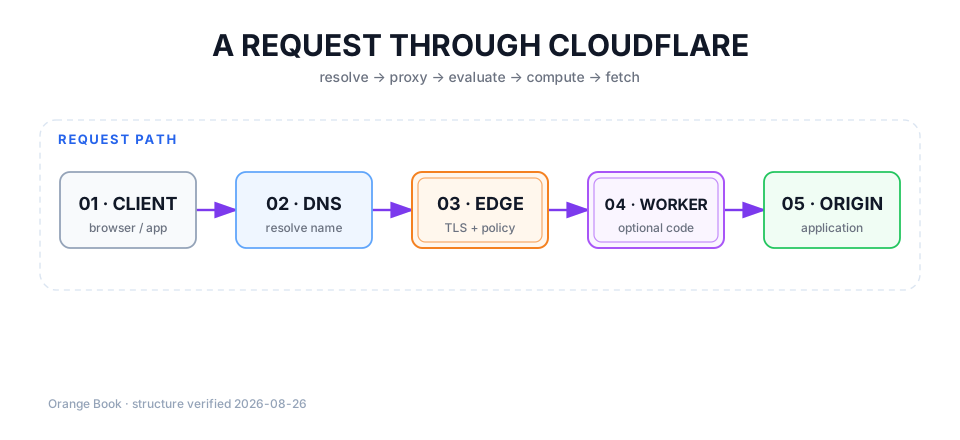
Detailed description
- 01Entry
A static page or API request.
- 02Resolve
DNS and proxying determine the entry path.
- 03Protect
TLS, WAF, and cache decisions precede application code.
- 04Execute
The Worker verifies identity, input, and tenant.
- 05Access resources
Read only the data needed by this flow.
A maintainable request
Classify the route first
Deliver static assets directly. Allow caching for public reads. Authenticate protected APIs and apply an additional role check to administrative actions. Avoid one universal handler that guesses every behavior.
Establish business context
Authentication produces userId and tenantId. Every D1 query binds a tenant predicate, and each R2 key uses a controlled prefix. A tenant ID submitted by the browser is never authorization by itself.
Move long work out of the request
Image batches, PDF parsing, indexing, and external API retries first create a job record, then send a Queue message or start a Workflow. Return a job ID and expose progress through a status endpoint.
Define responses and observation
Success, invalid input, unauthorized access, missing resources, and downstream failure receive stable error codes. Logs include request ID, version, and an internal error category, but not secrets, complete tokens, or unnecessary personal data.
How four projects differ
SaaS
CMS
Image utility
PDF utility
Completion checkpoint
Write a five-line responsibility map for your project. Each resource should have one primary job and a defined user-visible failure. If the design keeps one request open for conversion, indexing, and notification, extract a background job before continuing.
For Next.js, complete the target-runtime compatibility gate. Use the D1 migration and recovery guide for database release. Next: choose a complete project.
Learn framework and platform responsibilities separately
For an application using TanStack Start, Router, or Query, use the TanStack ecosystem map to assign routing, SSR, Server Functions, and server-state responsibilities. Then return here to map static delivery, request logic, data, and background work onto Cloudflare. The related technology guide network covers the other runtime and data topics.
Primary sources
Did this page help you complete your goal?
Beta feedback is generated in this browser and is never uploaded automatically.
Learning path: domain to first edge API
Four progressive modules cover the request model, Worker development, verification, and Free-plan limits.
Deploy an AI-built Next.js application to Cloudflare Workers
Put compatibility ahead of migration, then choose among static output, vinext, OpenNext, and retaining the current host with a rollback path.